Success Stories

Real projects — custom software, AI, and data solutions we've delivered.

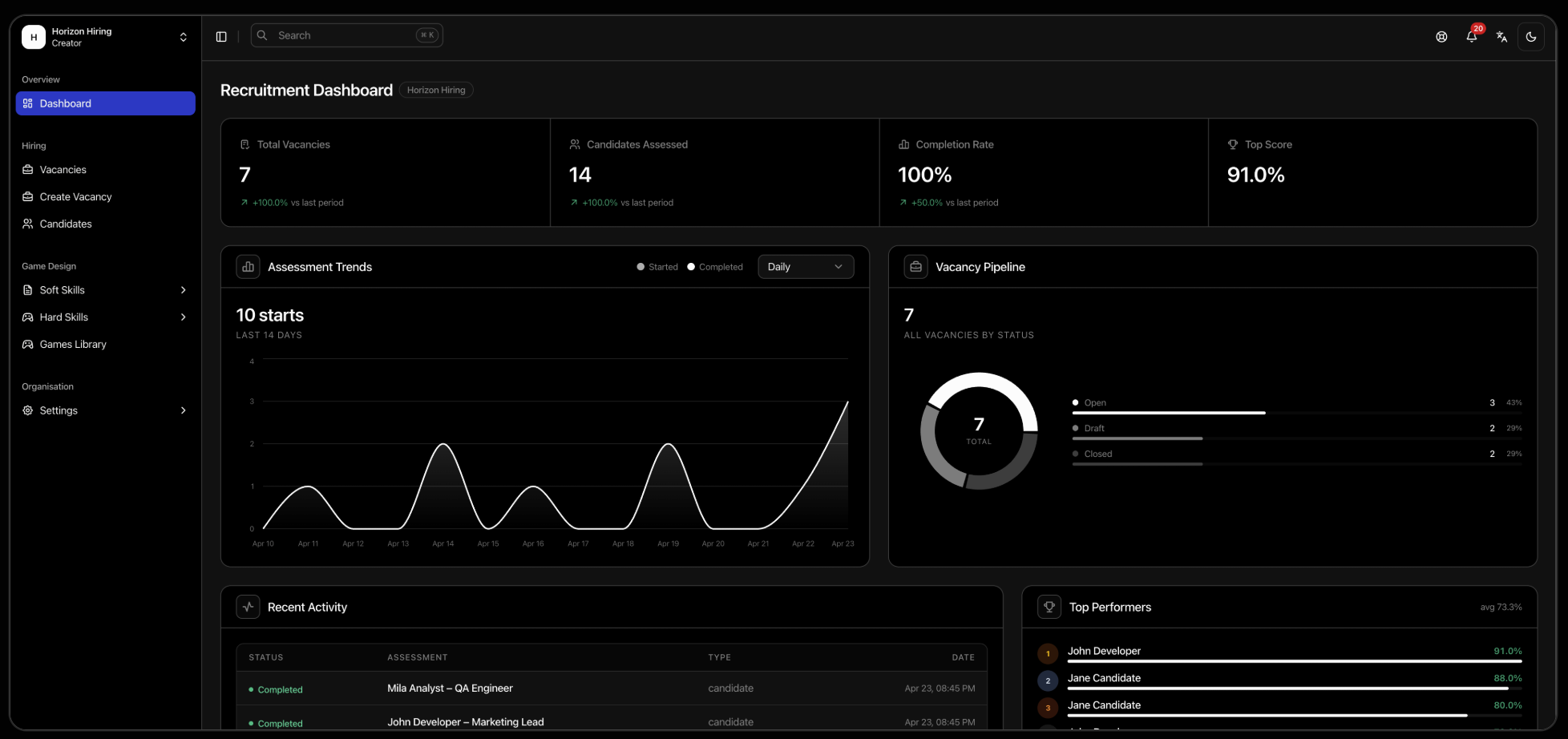
Assess4me — Gamified Recruitment Platform
Full-StackGamificationSSOAI Reviews

Assess4me — Gamified Recruitment Platform

Full-stack hiring platform where candidates complete games and quizzes; AI reviews every assessment and gives recruiters ranked insights, feedback, and recommendations.

Read more

Assess4me is a full-stack recruitment platform we built to replace guesswork in hiring with structured, engaging assessments. Recruiters create vacancies, pick cognitive games for soft skills and scored quizzes for hard skills, and invite candidates via share links or email. Candidates sign in through SSO and complete short, game-based sessions (typically two to six minutes per game) that measure focus, memory, decision-making, and creativity alongside technical knowledge. Every run is reviewed by AI at game, category, and vacancy level—with skill-by-skill explanations—so hiring teams see not just scores, but why a candidate fits a role.

Approach: We designed the product around a recruiter dashboard (vacancy pipeline, candidate tracking, leaderboards) and a candidate experience built from eight built-in cognitive games plus customizable quizzes. SSO keeps onboarding friction low for growing teams and agencies. The AI review layer aggregates performance across games and quizzes, supports side-by-side candidate comparison, and surfaces recommendations so recruiters can move from vacancy setup to a data-informed shortlist in four clear steps: create a vacancy, pick assessments, invite candidates, review AI insights.

Result: Assess4me gives hiring teams one workflow for soft and hard skills—interactive games candidates actually finish, quizzes for domain knowledge, and AI-generated reviews that explain every score. Recruiters compare candidates on ranked leaderboards, drill into per-skill feedback, and hire with confidence instead of relying on interviews alone. The platform is live at assess4me.com.

Visit website

CRIPI Blog & Knowledge Platform
BlogKnowledge PlatformCOST Action CA24141Sustainability

CRIPI Blog & Knowledge Platform

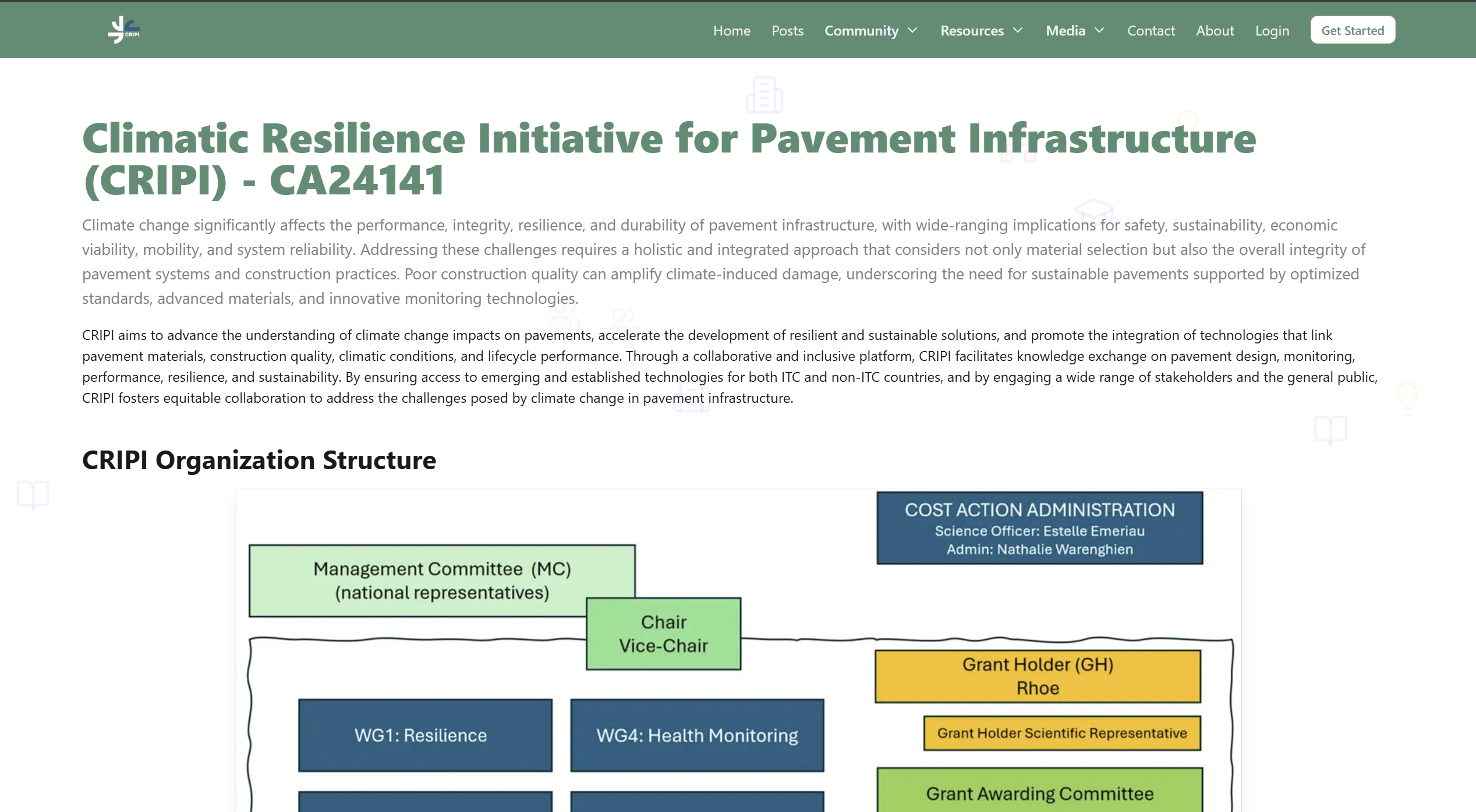
Blog and knowledge platform for CRIPI (CA24141) on climate change impacts on pavement infrastructure, resilience, sustainability, and equitable collaboration.

Read more

Climate change significantly affects the performance, integrity, resilience, and durability of pavement infrastructure, with wide-ranging implications for safety, sustainability, economic viability, mobility, and system reliability. Addressing these challenges requires a holistic approach that considers material selection, overall integrity of pavement systems, and construction practices. Poor construction quality can amplify climate-induced damage. CRIPI (CA24141) aims to advance the understanding of climate change impacts on pavements, accelerate the development of resilient and sustainable solutions, and promote technologies that link pavement materials, construction quality, climatic conditions, and lifecycle performance.

Approach: Through a collaborative platform, CRIPI facilitates knowledge exchange on pavement design, monitoring, performance, resilience, and sustainability. We built a blog and knowledge site that supports the CRIPI organisation structure, ensures access to emerging and established technologies for both ITC and non-ITC countries, and engages stakeholders and the public for equitable collaboration.

Result: The CRIPI platform fosters equitable collaboration to address climate change challenges in pavement infrastructure. It provides a central hub for research, standards, and best practices, and supports the organisation structure needed for inclusive, international cooperation. The platform is live at cripica.com, where the CRIPI community shares updates and resources.

AR & VR for Healthcare Environments
Augmented RealityVirtual RealitySpatial Computing3D Visualization

AR & VR for Healthcare Environments

Augmented and virtual reality experiences for demanding clinical settings—spatial visualization, hands-free guidance, and immersive training, including applications in dental care.

Read more

YViOS develops augmented reality (AR) and virtual reality (VR) solutions that blend digital information with real-world clinical workflows. We build experiences where 3D models, overlays, and interactive content align with the physical environment—so practitioners can visualize complex information in context, train in realistic scenarios, or work hands-free when precision matters. Our work spans head-mounted displays, spatial mapping, and real-time 3D rendering tailored to regulated, high-stakes environments such as healthcare and dental practices.

Approach: We start from the practitioner's workflow and the constraints of the care environment—lighting, hygiene, ergonomics, and integration with existing tools. We prototype spatial experiences on suitable AR/VR hardware, validate alignment and usability with stakeholders, and iterate on performance, comfort, and clarity of the digital overlay. The stack combines 3D content pipelines, spatial anchoring, and application logic designed for reliability in daily use.

Result: Clients gain a partner capable of delivering end-to-end AR and VR—from concept and spatial design through to deployable experiences. The approach demonstrates that immersive technology can support real clinical work: clearer spatial understanding, safer training, and digital guidance that respects the room the professional is already in—without overselling novelty for its own sake.

Industrial Site Drone Monitoring
DronesReal-time MonitoringIndustrial IoTOperator Dashboards

Industrial Site Drone Monitoring

Drone-based oversight of industrial sites delivering real-time information to operators, enabling faster and better-informed decisions.

Read more

YViOS designed and delivered a drone-based monitoring solution to help oversee industrial sites and provide real-time information to operators so they can make better decisions. The system provides live aerial views, sensor data, and analytics directly to control rooms, improving situational awareness and response times across large or hard-to-access areas.

Approach: We integrated drone fleets with existing industrial systems and built operator dashboards that aggregate live video, telemetry, and alerts. Operators can request overflights, track assets, and respond to incidents using a single interface, with data streamed and stored for compliance and analysis.

Result: Operators gain real-time visibility over industrial sites without being on the ground, leading to faster incident response, better resource allocation, and improved safety. The solution scales across multiple sites and supports both routine monitoring and ad-hoc inspections.

Test Amplifier for Smart Contracts
LLMSoliditySmart ContractsAI Testing

Test Amplifier for Smart Contracts

AI-powered test generation system for Solidity smart contracts using Large Language Models to automatically generate and improve tests, increasing code coverage and fault detection.

Read more

Our Test Amplifier focuses on leveraging Large Language Models (LLMs) to automatically generate and improve tests for Solidity smart contracts. Smart contracts can be seen as programs that run on blockchain platforms like Ethereum. Because they are immutable (cannot be changed once deployed) and often manage financial assets, even small errors can have serious consequences. Thorough testing is therefore essential. A broader and smarter test suite not only catches more edge cases but also increases confidence in the contract's reliability.

Approach: We explored three approaches: LLM-based amplification using pretrained language models (GPT, Claude) to produce context-aware tests; Search-based amplification applying algorithmic exploration to diversify inputs; and a Hybrid strategy combining both methods to refine LLM-generated tests using search-based methods for highest coverage.

Result: Our approach improves smart contract reliability, reduces manual testing effort, and lays a foundation for scalable, automated testing workflows. It can be directly deployed into multiple different applications, making it easy to integrate with existing developer toolchains such as Hardhat or CI/CD pipelines. This ensures that teams can benefit from AI-powered test amplification without having to change their current workflows.

Agent-Based Robotics System
Agent-Based SystemsRoboticsComputer VisionPathfinding

Agent-Based Robotics System

Development of an automated robot demonstrating autonomous decision-making, agent collaboration, and adaptive behaviour in dynamic environments using multiple cameras and sensors.

Read more

We have experience with agent-based systems, applied in real-world robotics projects. A highlight is the development of an automated robot demonstrating autonomous decision-making, agent collaboration, and adaptive behaviour in dynamic environments. The robot uses multiple cameras and sensors to detect objects and scan its environment, and advanced physics and pathfinding techniques ensure safe navigation. Multiple agents collaborate to make decisions and dynamically adapt their behaviour as the environment changes.

Approach: The robot combines information from cameras and sensors to identify objects and accurately model the environment. This enables the agents to make well-informed decisions and respond quickly to changes. Additionally, mathematical models are used to ensure the robot can efficiently navigate complex environments, avoid obstacles, and safely pick up objects without losing stability. Because multiple agents collaborate, they can often select the best actions in unexpected situations.

Result: This project demonstrates the power of agent-oriented programming for building intelligent, flexible, and robust systems. It highlights our expertise in advanced software engineering and robotics, and shows that our solutions are directly applicable to real-world projects. During development, the robot was rebuilt several times to achieve an optimal balance between speed, stability, and compactness, allowing it to pick up objects and maneuver under obstacles.

Interactive A/B Testing Dashboard
A/B TestingData AnalysisRecommendation SystemsInteractive Dashboards

Interactive A/B Testing Dashboard

Interactive dashboard for a store enabling A/B testing between different recommendation algorithms, with real-time analysis and comparison of algorithm performance to maximize profit.

Read more

We have experience building interactive dashboards connected to databases and capable of handling large datasets. In one of our projects, we developed a dashboard for a store that enabled A/B testing between different recommendation algorithms. This allowed us to analyse and compare the performance of each algorithm in real time, helping the store optimally recommend products and maximise profit. The data we received included information about the products sold by the store, transactions, prices, and times of sale.

Approach: First, all store data was consolidated into a database, linking transactions, product information, and sales timestamps. Next, systematic A/B tests were conducted between algorithms (e.g., ItemKNN versus Popularity). Comparisons were made based on various metrics. Analyses were extended to patterns such as product combinations, seasonal trends, and algorithm efficiency over time. Results were presented on an interactive dashboard, allowing the store to easily gain insights into the best algorithms, top-selling products per period, and other relevant metrics.

Result: This project demonstrates how data analysis and AI recommendation systems can directly create value for businesses. The dashboard provides the store with clear insights into which strategies work best, when products are sold most, and how product combinations influence purchasing behavior. The result is a fully deployable system that supports real-time analyses and enables strategic optimization of sales processes.